
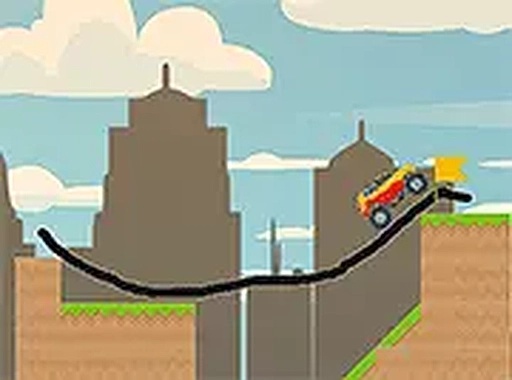
Sketch Path Puzzle Challenge
In Sketch Path Puzzle Challenge, you draw routes to help a car reach its goal. Each level offers a new layout that requires careful planning and creative thinking. The game is free, works on phones and tablets, and has no time limits.
Reviews
About this game
Drawing as a Puzzle Mechanic
Sketch Path Puzzle Challenge turns drawing into a strategic tool. Instead of selecting pre-made pieces, you use your finger or mouse to create roads and supports directly on the screen. The car then follows your sketch. This approach makes each puzzle feel personal and encourages experimentation. You can try a straight line, a curved path, or even a looping route. The game does not restrict your creativity, so you can explore different shapes until you find one that works.
Level Design and Progression
Early levels introduce simple gaps and gentle slopes. As you advance, you encounter wider chasms, uneven terrain, and obstacles that block direct paths. The layouts become more intricate, requiring you to think about weight distribution and balance. Some levels may have multiple routes, and you must decide which one is safest. The difficulty increases gradually, ensuring that you learn new strategies without feeling overwhelmed. Returning players will find fresh challenges that test their spatial reasoning.
Accessibility and Platform Support
This game is designed for a wide audience. It runs in a web browser, so you do not need to install any software. The interface adapts to touchscreens and mouse input, making it comfortable on phones, tablets, and computers. A full screen option helps you focus on the puzzle without distractions. The controls are simple: draw, erase, and test. There is no text-heavy menu or complex settings, which lowers the barrier for younger players or those new to puzzle games.
Creative Problem Solving
Unlike many puzzle games that have a single correct answer, Sketch Path Puzzle Challenge rewards creative solutions. You might find that a longer, winding road is more stable than a short bridge. Or you might use extra supports to reinforce a weak point. The game does not penalize you for trying unusual approaches. This freedom turns each level into a mini design project. Observing why a route fails and adjusting it is part of the learning process. Over time, you develop a better sense of how to plan efficient and safe paths.
Visual Style and Feedback
The graphics are clean and straightforward, with a focus on clarity. The car, obstacles, and terrain are easy to distinguish, which helps you plan your drawings. When the car moves along your route, you can see exactly where it struggles. This visual feedback is immediate and instructive. If the car falls or hits an obstacle, you can quickly identify the problem area and modify your sketch. The minimalist design keeps the attention on the puzzle itself, avoiding unnecessary distractions.








Comments
0 comments