
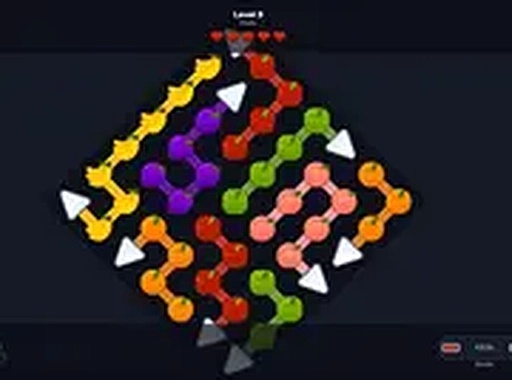
Food Arrow Logic Puzzle
Food Arrow Logic Puzzle asks you to clear a board of food items by launching each along its arrow. The catch: launch order matters, because items collide if their paths cross at the wrong time.
Reviews
About this game
What You're Actually Solving
Every board in Food Arrow Logic Puzzle is a set of food items, each paired with an arrow that defines its exit path. Your job is to send them all off the board. The puzzle isn't in the launching itself—it's in the sequence. Two items whose paths intersect will crash if launched too close together, so you have to spot those intersections before you click anything. The game is less about reflexes and more about reading a static layout and predicting how it will change as pieces disappear.
How a Level Plays Out
You start by scanning the board for overlapping routes. Items that share no path with anything else are safe to launch immediately; they're essentially free moves that reduce clutter. The hard decisions come from items whose arrows cross or run parallel. Launching one might clear a lane for another, or it might block a third piece still waiting. A collision doesn't end the game permanently—you can restart the level and try a different order. That restart loop is the core feedback: each failed attempt tells you which pair of items can't go back-to-back.
Controls and Difficulty Curve
Input is limited to clicking or tapping an item to launch it. There's nothing to drag, no timer, and no resource to manage, which keeps the focus entirely on planning. Early levels tend to have few overlapping paths, so the correct order is often obvious within a few seconds. Later boards add more items and more intersections, which means longer chains of dependent moves. The difficulty rises through layout complexity rather than through new rules, so the skill you build early—tracing paths and ordering moves—carries directly into harder stages.
Who It Suits
Because there's no download, no account, and no mature content, this is a puzzle that works for a wide age range and for short sessions. It rewards patience more than speed. Players who enjoy untangling dependencies—similar to the satisfaction of solving a nonogram or a sliding-block puzzle—will get the most out of it. Anyone looking for action, story, or multiplayer competition won't find it here; the entire experience is the logic problem on screen.


Comments
0 comments